Censorship/Book Bans
Censorship/Book Bans
Censorship/
Book Bans

Nonfiction Banned Book List: Schools Banning More History, Health, Memoir and More
May 19, 2026
Below is a list of some of the banned nonfiction titles documented in PEN America’s latest report on book bans in public schools nationwide. Facts & Fiction: Stories Stripped Away By Book Bans reports a doubling of bans on nonfiction titles on subjects from history and health to general knowledge, including biographies and memoirs. The report shows 29% of the unique titles banned over the 2024-2025 school year were nonfiction and notes that removing books about real events or people underscores “an embrace of anti-intellectualism.”
The report gives analysis of the content of the 3,743 unique titles that were removed from school libraries and classrooms from July 1, 2024 to June 30, 2025. Over this same period, PEN America tracked 6,780 total instances of bans across 23 states. The books listed below are examples of banned titles; they are not a ranking. Read More

Heidi Stevens: A glimpse at Warsaw history reinforces why books and literacy are vital for democracy
May 15, 2026
I recently traveled to Warsaw, Poland, for the fourth annual international Literacy for Democracy conference. Organized by the Polish nonprofit Universal Reading Foundation, the conference advocates for programs and policies that promote literacy across all ages, arguing that literacy isn’t just a cultural matter, but a survival factor for democracy, mental stability and economic success.
When I’m not writing this column, I work for the TMW Center for Early Learning + Public Health, a nonprofit research institute at the University of Chicago that works to understand and promote healthy brain development in the first five years of life.
As you can probably guess, just about every neural connection that promotes lifelong literacy catalyzes (or doesn’t) in those first five years. It was in that role that I attended the conference.
Leaders from across the world showed up to exchange ideas for promoting and protecting reading — a refreshing and hopeful departure from watching world leaders exchange much more nefarious ideas. Read More

Five Years of Banned Books Data and What Do We Know?
May 15, 2026
This spring marks five years of escalating attacks on books and libraries in America. Throughout 2026, organizations across the spectrum will be marking this anniversary, both to emphasize how long and complex this battle has been and to champion and celebrate the work being done to protect equitable access to books and libraries.
Let’s begin, though, with what we can count and track most easily: banned books from between 2021 and 2026.
There are currently four authoritative lists of banned book titles. These are books we know have been banned based on reported and/or published data, as well as because they’re on a state-sponsored list of banned titles. Most of the books banned in America go undocumented, so what we know from these lists represents but a fraction of how widespread the practice of literary censorship is. Read More
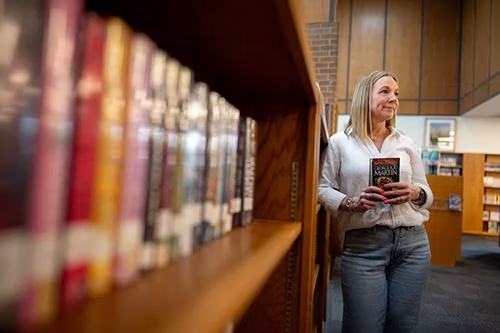
In Utah, nearly all statewide book bans originate from just 2 school districts, sending novels to the shredder, Tribune finds
May 14, 2026
“The Bluest Eye” by Toni Morrison is bound for the shredder.
Three copies of the novel sit in the librarian’s office at West High School, out of reach from students.
The book was banned April 17, about two weeks prior. When the notice came, Kara Budge, the school’s librarian, said she alerted teachers and staff, reminding them that they can no longer keep copies in their classrooms.
“Students can’t use it for a report or class project,” Budge said. Students can still carry personal copies, she explained, but any assignments were now off limits.
But West High didn’t ban it. Neither did the Salt Lake City School District, where the school sits.
Three other Utah school districts did. Each found “The Bluest Eye” amounted to pornographic or indecent content, or as Utah code calls it, “objective sensitive material.” Read More

Mahmoud v. Taylor (2025): An analysis of the effects of the Taylor case on Montgomery County School
May 12, 2026
Mahmoud v. Taylor, 606 U.S.__ (2025) (Taylor) is a United States Supreme Court decision that fundamentally changed the way educators and schools teach in the classroom. It enables a slippery slope about what can and cannot be included in the public education system.
In 2023, the Montgomery County Board of Education, in the State of Maryland, introduced numerous LGBTQ+ texts into the school curriculum. These texts were approved for students from Kindergarten through Fifth grade. Some parents did not like the texts being provided. The School Board initially agreed to notify the parents that the texts would be taught in the classroom and allowed the parents to choose the option of excusing their child. After finding this to be an academic disturbance, the School Board later revoked the option for students to be excused. Tamer Mahmoud, the parent of three children in this county, wrote to the School Board listing numerous implications for his faith if the school were to keep the inclusive stories in the classroom. Tamer Mahmoud wrote that: Read More

Number of nonfiction books banned in schools has doubled, report says
May 7, 2026
Nonfiction books were censored at schools at more than double the past rate in the 2024-2025 school year, according to a new report by PEN America.
The organization, whose stated mission is to “celebrate creative expression and defend the liberties that make it possible,” began monitoring book bans in 2021.
The May 7 report, “Facts & Fiction: Stories Stripped Away By Book Bans,” found that 3,743 unique titles were removed from school classrooms and libraries from July 1, 2024, to June 30, 2025. There were 6,780 total bans across 23 states during that period, according to the organization.
More than 1,000 of the titles – 29% – were nonfiction works, which the organization said was more than double the number from the previous year. Read More

Pine-Richland School Board revises controversial library book policy
May 5, 2026
The Pine-Richland school board voted Monday to approve a set of revisions to its controversial library book policy.
Changes reverse measures passed last year that expanded the board’s role in library book selection, broadened parental control over which books are part of the district’s collection, and prohibited librarians from acquiring any materials with “pervasive vulgarity or profanity” or “explicit sexual content.”
The board approved the revision by a 5-4 vote.
“The revised policy is built on the understanding that there are diverse viewpoints and strongly held beliefs in our community and related to this topic,” according to agenda item details published by the district. “Since library books are optional for students (i.e., not required like a core text), each book should be educationally suitable for some students in the school, but each book does not have to be educationally suitable for every student in the school.” Read More

Book bans and culture wars came for libraries. They’re still standing strong.
April 24, 2026
Sarah DeMaria still remembers how close she came to resigning from her role as a school librarian.
It was the summer of 2023, and after a year of vicious personal attacks, politically motivated book challenges and police reports to flag so-called pornographic content in the library, DeMaria had enough.
She packed up her office with no plan to return to the Hempfield School District in South Central Pennsylvania. But then she thought about her students: “If I left, who was going to be their voice?” she wondered. “Who was going to protect their books?”
Focusing on the young people she serves keeps DeMaria grounded as libraries, in and out of schools, have become targets of the nation’s culture wars on race, gender and sexuality. During National Library Week, which ends Saturday, librarians across the country are fighting to maintain students’ access to books and to keep their jobs amid cuts to library programs and persistent efforts to restrict reading materials. Read More

2025 broke record for censorship: Less than 3% of book challenges came from parents
April 23, 2026
Less than 3% of book challenges in 2025 came from parents, and a full 92% were initiated by groupsor government officials, according to an analysis of book challenges at public, school and college libraries published Monday by the American Library Association. The remaining 5% came from library users or unknown sources.
The percentage of challenges originating with sources other than individual parents jumped from 2024, when it stood at 72%.
Some two-thirds of the challenged books, or about 5,668, went on to be banned, and an additional 920 titles were restricted in some way. That’s the highest number of titles censored in a single year and highest rate of censorship recorded between 1990 and 2025, according to ALA. Read More

Book bans remain high; over 4,200 titles challenged in 2025
April 21, 2026
The American Library Association says book bans remain high; 2025 saw the second-highest number of book challenges to restrict or remove a book documented by the ALA.
More than 4,200 unique titles were challenged in 2025.
“A book challenge is any time a community member disagrees with a book that is in a library’s collection, and then they work with the library, with the community, to decide whether or not it belongs there,” said Dr. Jennifer Brown, the executive director of the Virginia Library Association.
The majority of the books challenged for removal were brought by groups or government officials, with just a small percentage by parents.
Dr. Brown says it could take weeks to months to get a book off the shelves. She says librarians in the state have to have an ALA-accredited library degree plus follow policies and procedures for how they handle book challenges. Read More

U.S. Army libraries target books with a focus on DEI or ‘gender ideology’ for removalU.S. Army libraries target books with a focus on DEI or ‘gender ideology’ for removal
April 15, 2026
A senior Army official ordered Army libraries, including West Point, to remove all books “with the explicit and sole purpose of directly and overtly promoting DEI, gender ideology, and critical race theory in a manner that subverts meritocracy and unity,” according to a memo sent last week by acting Assistant Secretary of the Army Derrick Anderson. It says the list of documents should be provided to the Army’s chief librarian by April 16th. The memo, dated April 9th, was viewed by NPR.”
The memo was sent to the Army’s Training and Doctrine Command, U.S. Army Special Operations Command, the Army’s Judge Advocate General’s Legal Center and School, the U.S. Military Academy and the Army War College. Read More

Federal Bill Targeting LGBTQ Content In Children’s Books Advances As Schools Threatened With Loss of Funding (Again)
April 15, 2026
The modus operandi is familiar: set LGBTQ+ people in the cross-hairs and threaten to withhold federal funding from institutions that don’t step in line with government ideology. Once again, the arrow points toward books.
Federal book ban bill, H.R. 7661 (“Stop the Sexualization of Children Act”) has advanced out of committee and may move forward this week for a vote on the House Floor. Sponsored by Rep. Mary Miller (R-IL), the bill targets children’s books that contain content that the bill defines as “sexually oriented material.”
While the category is broad, and does not specifically say that all LGBTQ content is banned, the wording is widely seen as potentially, and dangerously, restrictive. It states that “sexually oriented material” includes “any depiction, description, or simulation of sexually explicit conduct” as well as content that “involves gender dysphoria or transgenderism.” Read More
A Bit of Good News: 3 Book Ban Bills Defeated in Florida
April 14, 2026
For the past three years, PEN America Florida has shown up each legislative session with a clear goal: to push back against censorship in our schools, colleges, and universities. This year, we focused on three bills that threatened to accelerate book bans and further restrict speech and learning in public education – and we’re relieved to report that with your help, none of them passed into law.
In partnership with our community and literary stakeholders, we pushed back through a robust mix of in-person legislative meetings in Tallahassee, op-eds, social media campaigns, and targeted action alerts. The battle is far from over, though—the Florida legislature is set to have a special session by the end of June.
The three bills we advocated against reflected a severe misunderstanding of what issues truly matter to Florida students, parents, educators, and communities. All three bills pushed a pro-censorship agenda that would shut out LGBTQ+ voices, discussions of race and racism, political and social movements, and the lived experiences of traditionally disenfranchised communities. Read More
100 Grassroots Groups Urge Congress to Reject Bill to Censor Books in Public Schools
April 14, 2026
PEN America today joined more than 100 grassroots literary and library organizations, along with publications, booksellers and publishers in calling on Congress to reject a bill that would in effect mandate book censorship in the nation’s public schools. The writers and free expression organization previously called H.R. 7661 “an affront to local control of education” and said it would inevitably lead to more book bans.
Kasey Meehan, director of PEN America’s Freedom to Read program, said: “HR 7661 threatens to suppress access to important books for students–a clear attempt to further erode the freedom to read in this country. That Congress would task itself with deciding what books belong in schools is absurd and yet another example of government overreach tormenting public schools and libraries. The bill’s focus on a limited number of “classic works” and explicit anti-trans language also signals the continued desire to censor identities and stories of people of color and LGBTQ+ people and books that reflect the lived experiences of young people today.” Read More
“Wrongheaded” Court Decision on Iowa Book Ban Law Upholds Bans in Schools for Titles with Sexual Content
April 7, 2026
PEN America today condemned two court rulings that vacated a preliminary injunction against Iowa’s book banning statute and held that schools or state legislatures “can categorically prohibit sexual content or profanity in school libraries without running afoul of the First Amendment.” One decision also vacated the district court’s preliminary injunction of a section of the statute barring school districts from providing any instruction on gender identity and sexual orientation.
Elly Brinkley, staff attorney for U.S. Free Expression Programs at PEN America, said: Read More

GLAAD, Little Bee Books Release New LGBTQ Titles Ahead of Pride Month
April 7, 2026
GLAAD, the world’s largest LGBTQ media advocacy organization, is proud to announce its continued partnership with Little Bee Books in celebration of two vibrant, affirming new titles publishing today: Something to Be Proud Of by debut author Anna Zoe Quirke and Sunflowers and Lavender by graphic novelist Maisy Valais.
As part of this partnership, GLAAD is supporting both titles through marketing and publicity efforts designed to connect these stories with readers nationwide. A portion of proceeds from each book will directly support GLAAD’s work to accelerate LGBTQ acceptance. Read More

Find your joy at the library: ALA urges communities and news media to stand against book bans
April 7, 2026
Libraries and local news are kindred in many ways, including a shared mission of supporting our communities and providing information. Both libraries and news media have also faced funding challenges, and they stand together on the front lines defending the First Amendment.
Sam Helmick is the American Library Association’s (ALA) president for the 2025-2026 term. Helmick’s affinity for libraries began in college. “I volunteered there as an undergrad. I fell in love, and I realized that when libraries say, ‘welcome to all,’ that’s what they mean. There is something for everyone.” Read More

Book Bans on the Rise in the US; Librarians, Writers, and Others Fight Back
March 26, 2026
U.S. government institutions and conservative, moneyed interests are leading a multipronged effort to ban books as part of a nationwide strategy to seize control of American society by first controlling education and the dissemination of ideas.
What is unfolding in America is more than just a battle over books; it is the conflagration of two warring visions of freedom for the soul of the nation. What is at stake is nothing less than democracy itself. Read More

WSU guest opinion: Modern censorship and its ancient roots
March 25, 2026
Censorship is a common and exasperating aspect of everyday life. Many people seem determined to prevent others from reading, watching or saying certain things. Whether in the context of politics, universities, K-12 schools, books, music, or ideas in general, attempts to muzzle individuals or groups never seem to end. Yet censorious folks are often outraged when someone seeks to limit their freedom of expression.
To solve the problem of censorship, the solution is actually simple: Censor those who want to censor others.
Just kidding! Read More

Reading Between the Lines: HR 7661 Seeks to Ban LGBTQIA+ Books
March 25, 2026
Children across the United States are being barred from reading books—not by their parents or teachers, but by their state governments. In January alone, Katy Independent School District banned over 140 LGBTQIA+ books from school libraries. Language around book bans has been intentionally ambiguous, but PEN America defines the process in clear terms as “…any action taken against a book based on its content and as a result of parent or community challenges, administrative decisions, or in response to direct or threatened action by governmental officials, that leads to a book being either completely removed from availability to students, or where access to a book is restricted or diminished.”
Book bans are, unfortunately, a time-honored tradition in many school districts. In fact, every year, the American Library Association (ALA) hosts a Banned Books Week, which was created in 1982 “…in response to a sudden surge in the number of book challenges in libraries, schools, and bookstores,” according to the ALA website. Read More

Central Pa. school board policy bans books that offend ‘good taste or propriety’
March 24, 2026
Southern York County’s elected school board approved a policy with broad language banning library books and any other material that “offends good taste or propriety.”
The language of the policy, adopted unanimously by members of the all-conservative board, is nearly identical to policies adopted by several other far-right school boards, including Pequea Valley in Lancaster County.
During Southern York’s March 19 meeting, board members said the library policy was drafted by the board’s solicitor. It’s not clear if any outside groups were also involved in its creation.
West Shore’s school board considered and ultimately tabled its own policy with similar language over concerns raised by administrators that it would inadvertently ban works by William Shakespeare and Geoffrey Chaucer. Read More

Southern York policy bans books that offend ‘good taste or propriety’
March 23, 2026
Southern York County’s elected school board approved a policy with broad language banning library books and any other material that “offends good taste or propriety.”
The language of the policy, adopted unanimously by members of the all-conservative board, is nearly identical to policies adopted by several other far-right school boards, including Pequea Valley in Lancaster County.
During Southern York’s March 19 meeting, board members said the library policy was drafted by the board’s solicitor. It’s not clear if any outside groups were also involved in its creation.
West Shore’s school board considered and ultimately tabled its own policy with similar language over concerns raised by administrators that it would inadvertently ban works by William Shakespeare and Geoffrey Chaucer.
That policy was based on one approved in the Adams County-based Bermudian Springs School District that, in turn, was drafted by the conservative, Christian Independence Law Center. The ILC has promoted book bans and anti-LGBTQ+ policies in districts across the state. Read More

Utah banned another book from all public schools, bringing the list to 28. Here’s what it’s about.
March 17, 2026
John Green’s debut novel “Looking for Alaska” is the latest addition to Utah’s growing list of titles banned from all public schools in the state.
The 2005 young adult fiction book follows 16-year-old Miles Halter, who leaves home to attend boarding school in search of the “Great Perhaps,” the famous last words of French poet François Rabelais.
There, he makes new friends, including Alaska Young. The group bonds over pranks and breaking school rules. But when Alaska unexpectedly dies, Miles and the others must confront some of life’s biggest philosophical mysteries.
“Looking for Alaska” was among the Top 52 books banned from U.S. schools in 2025, according to PEN America, a nonprofit that advocates for free expression.
Green late last year called it “strange” that his book was among the top banned titles, more than two decades after it was published. Read More

‘Dangerous’ bill inviting government censorship passes House committee
March 18, 2026
In response to the March 17 Committee on Education and Workforce hearing, American Library Association President Sam Helmick issued the following statement on H.R. 7661, a bill that threatens funding promised by the Elementary and Secondary Education Act of 1965 from any school that develops, implements, facilitates, hosts or promotes any program or activity for, or provides or promotes literature or other materials to, children under the age of 18 that include “sexually oriented material”:
“H.R. 7661 is a dangerous bill that steals the power to choose what kids read away from parents, local communities and well-trained educators and librarians, and gives it to politicians in Washington, D.C. Congress is not authorized to make decisions about what kids read in school, and it is not allowed to interfere with the rights of states and communities to control their own schools. Read More

Florida Leads the Country in Book Bans. It’s About To Get Worse. (Plus, More Library News)
March 17, 2026
For this round-up of library links, we’re focusing on censorship news (actually, a lot of censorship news), updates from the eternal Trump vs. Publishing & Libraries conflict, and a handful of interesting miscellaneous articles. Let’s dive in.
Library Updates
American Library Association’s Office for Intellectual Freedom unveils new and updated resources to protect the freedom to read
March 11, 2026
The American Library Association’s Office for Intellectual Freedom (OIF) launched significant updates to tools to help library workers, advocates and the public combat book banning and to stay informed on the latest censorship cases around the country.
The goal of OIF is to educate library workers and the public about the nature and importance of intellectual freedom in libraries.
“The Office for Intellectual Freedom is proud to offer practical tools that provide clear guidance and support for library professionals as they continue to protect the right to read,” said Sarah Lamdan, OIF Executive Director. Read More

11 Famous Novels Written by Women That Were Banned
March 10, 2026
Book bans are nothing new. In 213 BCE, the Chinese emperor Shih Huang Ti is believed to have ordered 460 Confucian scholars to be buried alive as part of an effort to consolidate power and suppress dissent. In the year 8 CE, the poet Ovid was exiled from Rome—and some scholars believe this had something to do with his writing Ars Amatoria (The Art of Love), a poem that describes the art of romance and seduction; the book was later banned again in the United States in 1930. And in the year 35 CE, the Roman emperor Caligula is believed to have banned Homer’s The Odyssey because it expressed Greek ideas of freedom that he believed were dangerous.
These are just a few examples of early book bans, but in more recent years, the United States has been the site of many more—and a large number of the books that have courted controversy in the U.S. in recent years have been written by women. If you’ve sat in a high school English class, you may have read Zora Neale Hurston’s Their Eyes Were Watching God, Toni Morrison’s Beloved, Margaret Atwood’s The Handmaid’s Tale, and many more on this lis, and it may or may not come as a surprise to you that each of these books has been banned at one point or another. Read More

ALA recognizes LGBTQ+ stories amid intensifying book bans
March 9, 2026
As debates over book bans continue across the United States, the American Library Association’s (ALA) 2026 Youth Media Awards recognized a wide range of LGBTQ+ authors and stories for young readers.
PEN America reported that more than 10,000 instances of book bans were recorded nationwide during the 2023–2024 school year, many involving LGBTQ+ titles and themes. In its report “The Normalization of Book Banning,” the organization described a growing pattern of coordinated efforts targeting books about race, gender identity and sexual orientation.
Legal disputes have also emerged. In Mahmoud v. Taylor, a Supreme Court case originating in Maryland, parents challenged a school district’s use of LGBTQ+-inclusive storybooks in elementary schools, arguing they should be permitted to opt their children out. The case has drawn national attention as courts continue weighing the boundaries between parental rights, public education and access to inclusive educational materials. Read More

ALA denounces federal book banning bill
February 26, 2026
In response to H.R. 7661, introduced on February 24, American Library Association President Sam Helmick issued the following statement:
“Parents, not politicians, should guide their children’s reading. In our school, campus, and public libraries, materials are selected by trained literacy professionals who understand child development and community needs. Their work is grounded in one clear purpose: helping young people become lifelong readers.
“H.R. 7661 isn’t fundamentally about protecting kids. It’s about giving politicians broad authority to restrict whose stories are allowed on our shelves. That should concern anyone who believes in the freedom to read and the right of families to make decisions for themselves.
“Rather than targeting librarians and teachers, Congress should invest in them. The Right to Read Act offers a better path, supporting well-staffed and well-resourced school libraries, strengthening evidence-based literacy instruction, and protecting the dedicated professionals who help young people discover books that open doors and expand horizons. When we trust families, support educators, and protect the freedom to read, our young people thrive.” Read More

‘The Librarians’ To Premiere On PBS ‘Independent Lens’ As Political Backlash Mounts Against Book Banning
February 12, 2026
Students in 10th grade English class at Elizabethtown Area High School will read about the fictional March sisters as they tended hearth and home during the Civil War in Louisa May Alcott’s beloved novel “Little Women.”
And, dipping into F. Scott Fitzgerald’s “The Great Gatsby,” they will immerse themselves in the Roaring Twenties to witness the wealthy Jay Gatsby’s tragic obsession with a former love.
What they won’t read for class are three teacher-recommended contemporary novels that have all received various literary accolades: “Turtles All the Way Down” by John Green, about a teen dealing with obsessive-compulsive disorder and anxiety while investigating a billionaire’s disappearance; “Station Eleven” by Emily St. John Mandel, whose characters survive in a post-apocalyptic world after a flu pandemic wipes out most of Earth’s population; and “Long Way Down” by Jason Reynolds, about a 15-year-old bent on avenging his brother’s murder and a minute-long ghostly elevator ride that makes him question his path. Read More

Pine-Richland suspends controversial library book policy, considers major revisions
February 11, 2026

28 banned Black books every American must read
February 11, 2026
Book bans across America have surged to unprecedented levels, with Black authors bearing the brunt of censorship efforts. This Black History Month, a powerful reading initiative challenges those bans head-on by spotlighting 28 essential works that schools and libraries have attempted to remove from shelves.
The campaign pairs each book with a liberation leader whose life embodied the same principles of resistance and transformation found within those pages. Together, they form a comprehensive education in Black history that extends far beyond February’s 28 days.
Why these books face censorship
The works targeted for removal share common threads. They confront uncomfortable truths about American history, explore the psychological impact of racism and challenge sanitized narratives taught in classrooms. Read More

Defending the freedom to read is not radical — it’s American
February 11, 2026
Political strategists and commentators are looking at Democrat Taylor Rehmet’s stunning special election victory in Texas state Senate District 9 to forecast electoral shifts ahead of 2026’s midterms. But those trying to understand this election’s surprise outcome also need to consider the local politics at play.
Rehmet’s opponent was Republican Leigh Wambsganss, chief communications officer of conservative media company Patriot Mobile. She has been a primary architect behind the movement to populate North Texas school boards with candidates willing to orchestrate an extreme, right-wing takeover of public schools. These school board takeovers resulted in unprecedented book bans and attacks on residents’ right to read. Read More

‘The Librarians’ To Premiere On PBS ‘Independent Lens’ As Political Backlash Mounts Against Book Banning
February 4, 2026
The Librarians is set to premiere on PBS this Monday, Feb. 9, after a robust theatrical and festival run that saw Kim A. Snyder’s documentary earn awards across the country.
The film, executive produced by Sarah Jessica Parker, will air on Independent Lens, the long-running public television series presented by ITVS. It examines the coordinated effort by conservative groups like Moms for Liberty to ban a wide range of books at public schools and public libraries nationwide, and the abuse librarians have received for defending the right of children to access reading material, including books with anti-racist or LGBTQ themes. Some right-wing ideologues have gone so far as to accuse librarians of “grooming” kids. Read More

Book Bans Are Leaving Authors Frustrated, Fatigued, and Frightened
February 2, 2026
When Andy Passchier heard the word nonbinary for the first time, they recognized almost instantly that it applied to them.
“I had spent 22 years feeling vaguely out of place, not quite right, uncomfortable in my skin and with how people perceived me, but I simply didn’t know that there were other ways I could be existing,” Passchier said. “Learning the word nonbinary was like opening a window and letting fresh air into a stale room for the first time, and I was able to begin truly exploring my identity.”
Passchier has always wondered what their life would have looked like if they were exposed to a more capacious understanding of gender earlier. Through the books they write and illustrate, like Gender Identity: For Kids and They, She, and He: Words for You and Me, they’ve strived to make that a possibility for kids today. Read More

Palmyra school board addresses backlash over French book ban discussion
January 23, 2026
After residents voiced their concerns about recent incidents that include the possibility of rejecting a popular French language reader, Palmyra school board members took time during their public meeting to address the backlash.
School board members Jan. 22 decided to place “Alice: La Liste” on their agenda for the Feb. 12 public meeting, with a recommendation to approve the book for the district. The administration recommended that it be used as a French 2 reader, for teachers to purchase as part of the district’s 2026-27 school budget and used in the spring 2027 for a French II class.
In a Dec. 19 committee meeting, two school board members said they would reject the book based on cultural topics and influences, saying it contains “fringe topics.” Since that meeting, the school district has received numerous comments, both in emails on online, about the potential banning of the French Reader. Read More

The Authoritarian Playbook: Librarians speak out against book bans
January 14, 2026
On this edition of Your Call’s Authoritarian Playbook series, we’re speaking with librarians featured in the new documentary, ‘The Librarians,’ about how they are fighting back against Republican backed book bans and standing up for the right to read.
Since 2021, there have been nearly 23,000 book bans in public schools nationwide, most targeting works about racism, sexuality, gender, and history, according to PEN America.
How are librarians responding?
Guests:
Martha Hickson, intellectual freedom advocate, and retired high school librarian in Annandale, New Jersey
Becky Calzada, district library coordinator in Leander, Texas, and co-founding member of the Texas #FReadom Fighters Listen Here
60+ Small Tasks to Defend the Right to Read: Book Censorship News, January 9, 2026
January 9, 2026
“What can I do to learn about book censorship and help put a stop to it?” This question and variations thereof continue to be the most common ones I come across. The answer is not just to buy the books. That is an act of consumerism, and while it has value, meaning, and purpose — especially for living authors whose works and lives are under attack — it is not a step toward ending book bans. It is a myth that book bans increase book sales and “help” an author whose work has been targeted. It is also a myth that book bans encourage young people to obtain the banned title.
The reality is that what’s at stake are our public institutions of democracy: public libraries and public schools. Also at stake are the lives of whole groups of people whose stories are being silenced, erased, and burned nationwide by a small, vocal, wealthy, and well-connected contingent of far-right politicians and Christian nationalists (sometimes those groups are the same). Read More

Wicked novel banned in Utah for ‘sensitive’ material: ‘Censorship makes schools more dangerous’
January 9, 2026
Wicked: The Life and Times of the Wicked Witch of the West, the novel which inspired Wicked the musical and subsequently Jon M. Chu’s epic cinematic adaption Wicked and Wicked: For Good, has been banned in Utah.
The 1995 book by queer author Gregory Maguire has been banned by the Utah State Board of Education due to “objective sensitive material”, under the state’s Sensitive Materials Law.
The Utah State Legislature defines “objective sensitive material” as content which “constitutes pornographic or indecent material”.
Utah’s Sensitive Materials Law, originally passed in 2022 and updated in 2024, enables the state to remove on a whim any books that it deems to be inappropriate for school-age children.
Unlike the musical film adaptation, which stars Cynthia Erivo and Ariana Grande as frenemies-turned-friends-turned-frenemies-again Elphaba and Glinda respectively, Wicked: The Life and Times of the Wicked Witch of the West does feature explicit and dark scenes including sexual assault. Read More

States Are Banning Book Bans. Will It Work?
January 7, 2026
At least eight states are trying to crack down on attempts to remove books in school libraries, passing legislation that gives librarians more leeway in selecting materials, sets up formal processes for responding to challenges, and bars schools from pulling books from the shelves for ideological reasons.
Dubbed “freedom to read” laws by supporters, this legislation has emerged over the last two years, a response to the growing number of challenges to books for content related to race and LGBTQ+ issues in the post-pandemic period.
The policies—passed in California, Delaware, Illinois, Maryland, Minnesota, New Jersey, Rhode Island, and Washington—vary by jurisdiction, but most state that books can’t be excluded from a public school library solely because of the background or views of the author. Nor can books be removed due to “partisan, ideological, or religious disapproval.” The laws also require schools to create and enforce a policy for responding to challenges from teachers, parents, or students that includes the input of library staff and school and district leadership. Read More

2025 Year in Review
January 2, 2026
Freedom to read faces federal scrutiny
Following the Trump administration’s executive orders targeting diversity, equity, and inclusion (DEI), the US Naval Academy removed nearly 400 books deemed DEI-related from its Nimitz Library (later returning most of them to circulation). Meanwhile, in April, the Supreme Court heard arguments in Mahmoud v. Taylor, a case brought by parents wishing to opt their children out of instruction that incorporates books with LGBTQ+ themes at Montgomery County (Md.) Public Schools. The Court ruled 6–3 in June that the district violated families’ First Amendment rights in not allowing such opt-outs.
New leadership at ALA
Dan Montgomery joined the American Library Association (ALA) as executive director on November 10, succeeding Leslie Burger, who had served as executive director on an interim basis since November 2023. Montgomery was previously president of the Illinois Federation of Teachers. Read More

Diversity Has Become a Dirty Word. It Doesn’t Have to Be.
January 6, 2026
I have an identical twin sister. Although our faces can unlock each other’s iPhones, even the two of us are not exactly the same. If identical twins can differ, wouldn’t most people be different too? Why is diversity considered a bad word?
Like me, my twin sister is in computing, yet we are unique in many ways. She works in industry, while I am in academia. She’s allergic to guinea pigs, while I had pet guinea pigs (yep, that’s how she found out). Even our voices aren’t the same. As a kid, I was definitely the chattier one, while she loved taking walks together in silence (which, of course, drove me crazy).
Just last month, universities have been changing the names of committees to remove the word “diversity,” magazines for women and Black students are being shut down, nonprofits providing scholarships for Hispanic students are being sued, and companies are eliminating their Diversity, Equity, and Inclusion (DEI) programs and stopping annual diversity reports. Read More

State senator makes second attempt to pass a right to read bill
December 8, 2025
The continuing right-wing assault on libraries, books and the right to read has left state legislators across the country scrambling to pass legislation protecting libraries and guarding against censorship. Pennsylvania can be included in that number.
In 2023, State Senator Amanda Cappelletti (D-Dist. 17) and State Representative Paul Friel (D-Dist. 26) attempted to pass a right-to-read bill. However, SB 926 did not move beyond committee in that session.
But since success in politics usually requires both patience and persistence, Cappelletti is bringing out another version of her right-to-read bill for 2026, SB 1103. In the new version, Cappelletti references the language and content of bills that have passed successfully in several other states. For instance, the current bill mirrors much of how Illinois’s bill operates. Read More

Utah Begins 2026 by Banning Three Books at All Public Schools Statewide, Leads U.S. In Bans
January 5, 2026
To begin the new year at public schools across the state, Utah officials banned three more books. Wicked: The Life and Times of the Wicked Witch of the West by Gregory Maguire, Nineteen Minutes by Jodi Picoult, and The Perks of Being a Wallflower by Stephen Chbosky join 19 other titles on a state-sanctioned ban list and must now be removed from all schools.
These new removals officially put Utah at the top of states with the most banned books, beating out South Carolina’s 21 bans.
Utah passed one of the strictest bills related to books in public schools in 2024. House Bill 29 (HB 29) allows parents to challenge books they deem “sensitive material” and it also outright bans books from all public schools in the state if those books have been deemed “objective sensitive material” or “pornographic” per state code in at least three public school districts or two public school districts and five charter schools statewide. The bill went into effect July 1, 2024, and it started with 13 titles on it. Read More

Commentary: Book banners are cowards afraid of social change
December 28, 2025
Book banners will tell you they’re the good guys. They’ll claim that they remove books in kids’ best interests, that they’re sparing young minds from inappropriate content or offensive language, that they’re defending parents’ rights. Book banners will say they protect readers of all ages — society at large, really — by suppressing the spread of dangerous ideas.
But the truth is that book banners are cowards. They impose their insecurities and limited worldview on the public because they’re afraid. Of change. Social progress. Losing their unearned privilege and power. They cling to control by restricting our access to information: accurate historical accounts, diverse storytelling, critical awareness. Book banners know that free people read freely and that reading increases our humanity; the subsequent autonomy, curiosity and empathy scare them into obstructing our right to read. Read More

Readers’ Choice in books 2025: Georgia book banners work in secret; anti-censorship is growing
December 26, 2025
Just in time for Banned Book Week, running from October 5 through October 11, PEN America announced on Wednesday that an unprecedented 22,810 books have been banned in the United States since 2021. Book censorship may seem less pervasive in Georgia than it is in states like Florida, Iowa and Texas, which dominate PEN’s banned books list. But Georgia’s public schools and libraries, along with the state Legislature, are no strangers to literary censorship, and the state’s pro-censorship activists use the same playbook as their more prolific counterparts.
“While the public reporting of school book bans in Georgia might be less than a state like Florida or Texas, similar pressures are visible in terms of legislation and advocacy groups,” said Tasslyn Magnusson, senior adviser to PEN America’s Freedom to Read program. Read More

U.S. Congress Members Reintroduce Federal ‘Right to Read’ Act
December 21, 2025
“I’m not really fearful anymore,” Mary Wood told me. Wood, 49, doesn’t dodge uncomfortable topics. But I’m unsure how much to credit this claim. Over dinner in late November at a chain restaurant near her home outside Columbia, South Carolina, she recalled the “constant state of fear” that enveloped her in February 2023 when she was first accused of wayward thought.
Two students in the AP Language class that she taught at Chapin High School, a National Blue Ribbon School, had reported Wood, a White English teacher who had graduated from Chapin herself, to a school board recently recast by members aligned with the right-wing Moms for Liberty movement. Wood’s offense was showing two short videos about racial discrimination and teaching Between the World and Me, a memoir of growing up, and living, Black in America by Ta-Nehisi Coates. Read More

Top 52 Banned Books: The Most Banned Books in U.S. Schools
December 16, 2025
The 52 most banned books of the last four school years include National Book Award and Pulitzer Prize winners, bestsellers, and beloved books by authors including Toni Morrison, Margaret Atwood, and Judy Blume.
Since PEN America began tallying school book bans in 2021, thousands of books have been targeted repeatedly – as many as 147 times for John Green’s popular young adult novel Looking for Alaska and 142 for bestselling author Jodi Picoult’s book centered around a school shooting, Nineteen Minutes. Seven of bestselling author Sarah J. Maas’ books appear in the top 52, along with seven by young adult author Ellen Hopkins.
PEN America has documented 22,810 cases of book bans in U.S. public schools since it began counting in 2021, wiping out everything from classic literature to children’s picture books. Bans have occurred in 45 states and 451 public school districts. Read More
PEN America Decries Supreme Court Decision on Book Ban Case
December 8, 2025
PEN America responded today to the Supreme Court decision to decline to hear Little v. Llano County, a case challenging book removals from the Llano County, TX public library, saying leaving a lower court ruling in place in effect allows state and local government to tell people “what they can and cannot read.”
Elly Brinkley, staff attorney for U.S. Free Expression Programs, said: “The Llano decision has already been used to uphold the devastating wave of book bans across the country. Leaving the Fifth Circuit’s ruling in place erodes the most elemental principles of free speech and allows state and local governments to exert ideological control over the people with impunity. The government has no place telling people what they can and cannot read.”
PEN America had previously criticized the lower court’s ruling for denying library patrons’ First Amendment right to receive information, and for embracing the dangerous application of the government speech doctrine to decisions about books in public libraries. Read More

The Supreme Court Just Opened the Door to a New Era of Book Bans
December 17, 2025
Imagine that you decided to go to your local library to check out a book but you couldn’t find it on the shelf. You ask the librarian for help locating it, but they inform you it’s not available—not because someone else has checked it out, but because the government has physically removed it after deciding they don’t want you to read it.
This isn’t the plot of a dystopian novel, it’s the reality that the U.S. Supreme Court has allowed in its recent decision to not hear arguments in the book ban case: Leila Green Little et al. v. Llano County. In leaving the Fifth Circuit ruling in place, SCOTUS effectively granted state and local governments in Louisiana, Mississippi, and Texas the authority to determine what materials you can and cannot read. This means people in these states do not have the same First Amendment rights as the rest of the country. And that should raise alarm for everyone.
In the U.S., efforts to remove books from school and public libraries have existed for many decades, but in the past few years the intensity has escalated. Read More

Supreme Court declines to hear Texas book ban appeal in case watched by free speech groups
December 8, 2025
The U.S. Supreme Court on Monday declined to hear an appeal on a Texas free speech case that allowed local officials to remove books deemed objectionable from public libraries.
The case stemmed from a 2022 lawsuit by a group of residents in rural Llano County over the removal from the public library of more than a dozen books dealing with sex, race and gender themes, as well as humorously touching on topics such as flatulence.
A lower federal appeals court had ruled that removing the books did not violate Constitutional free speech protections.
The case had been closely watched by publishers and librarians across the country. The Supreme Court’s decision to not consider the case was criticized by free speech rights groups.
The Texas case has already been used to ban books in other areas of the country, said Elly Brinkley, staff attorney for U.S. Free Expression Programs at PEN America. Read More

U.S. Congress Members Reintroduce Federal ‘Right to Read’ Act
December 8, 2025
Saying that literacy “opens the door for lifelong opportunity and economic success” U.S. Senator Jack Reed (D-RI) and U.S. Representative Adelita Grijalva (D-AZ-07) this week introduced—or more accurately—reintroduced the Right to Read Act, a bill that proposes to “surge” federal investment in support of student literacy, support the “recruiting and retention of school librarians and staff,” and combat the rise of censorship in schools.
The bicameral bill was first introduced in 2022 by Reed and Adelita’s father, longtime Congressman Raúl Grijalva, who died at the age of 77 while battling cancer. Adelita Grijalva won election to her father’s seat in a special election in September. The bill was also reintroduced in 2023, but failed to advance.
While the text of the recently reintroduced bill has not yet been filed, the lawmakers said in a joint release that the legislation would once again seek to support “evidence-based reading instruction, well stocked and staffed school libraries, family literacy programs, a wide range of reading materials, and the freedom to choose what to read.” Read More
Why the Florida Department of Education’s Book Ban Numbers Are a Vast Undercount
December 4, 2025
Each fall, the Florida Department of Education releases a report of “removed or discontinued” materials for the prior school year. The report on the 2024-25 school year documented 414 book bans across public school districts in the state – a significantly smaller figure than PEN America’s Index of School Book Bans and Florida Freedom to Read Project reports.
PEN America, in partnership with Florida Freedom to Read Project, tracked more than 2,300 book bans in Florida during the 2024-25 school year.
Why the difference? PEN America defines a book ban as any action taken against a book based on its content that leads to access to that book being restricted or diminished. PEN America has tracked the bans of unique titles nationwide since 2021 using publicly available data sourced from school district websites, school board minutes, public records requests, coverage by local journalists, and through collaboration with advocacy partners. Read More

A Growing Coalition Fights Censorship in California’s Public Schools
December 3, 2025
A bill signed into law this year in California under the guise of curbing antisemitism brings President Donald Trump’s attacks on education to the state’s public schools. Assembly Bill (AB) 715 expands the state’s authority to ban instructional material in K-12 schools based on ill-defined standards.
It has been widely reported that the bill passed without opposition, as lawmakers who spoke out against it abstained rather than voted no when it came time to do so. But that narrative could not be further from the truth: A diverse coalition of over 100 civil rights and racial justice organizations, religious congregations, and groups of parents, educators, and students mobilized against AB 715 — and shows no signs of stopping now that it has passed.
“We are committed to continuing to fight AB 715 in its implementation and do whatever we can to roll back the harms that we believe were intended by this bill from the beginning,” said Lara Kiswani, executive director of AROC Action and an organizer with the California Coalition to Defend Public Education (CCDPE). Read More

When book bans enter the classroom, students lose
December 3, 2025
On a recent trip to my public library, as I was scanning my books, a young boy next to me asked the librarian behind the desk how many books our library branch has. The answer was in the tens of thousands. After hearing this, the boy asked his mother if that was the same amount of books in his school classroom. She told him his class has 4,000 books, and she knew because she had scanned every single one of them.
Why? Well, a new law in North Carolina requires every book in every classroom to be listed online so parents can see every single book their children might have access to. This law was passed this summer, then vetoed by Gov. Josh Stein. That veto was overridden by the North Carolina General Assembly.
Schools started in August without a lot of guidance, and many teachers were scrambling to comply with the new law. Teachers across the state were given a variety of information: Read More

Banned books judged by covers
December 3, 2025
On a recent trip to my public library, as I was scanning my books, a young boy next to me asked the librarian behind the desk how many books our library branch has. The answer was in the tens of thousands. After hearing this, the boy asked his mother if that was the same amount of books in his school classroom. She told him his class has 4,000 books, and she knew because she had scanned every single one of them.
Why? Well, a new law in North Carolina requires every book in every classroom to be listed online so parents can see every single book their children might have access to. This law was passed this summer, then vetoed by Gov. Josh Stein. That veto was overridden by the North Carolina General Assembly.
Schools started in August without a lot of guidance, and many teachers were scrambling to comply with the new law. Teachers across the state were given a variety of information: Read More

Faith for Libraries
November 30, 2025
About the campaign
Attempts to remove and censor reading materials in libraries have spiked in recent years under the pretense that censorship reflects people of faith and protects religious freedom. In reality, these efforts do not represent the vast majority of Americans from diverse faith traditions and censorship in libraries threatens-not defends-religious liberty.
The Faith for Libraries: Diverse Faith Communities Supporting Libraries and Librarians campaign brings together people of faith, library workers, and other library advocates as a collective force to champion the freedom to read and protect libraries as community spaces for everyone. Attempts to remove and censor reading material in libraries have spiked in recent years and censors often claim that they are speaking for people of faith and defending religious freedom. But they do not represent the majority of Americans from our diverse religious communities and censorship in libraries threatens–not defends–religious liberty. Read More

Our libraries must offer a wide range of diverse books [letter]
November 23, 2025
I am writing to express my strong support for the continued availability of a wide range of books in our school libraries and to oppose efforts to ban or censor reading materials for students.
Books are the foundation of education and understanding. They open doors to new worlds, ideas and perspectives. When we remove books from school libraries, we are not simply eliminating words on a page — we are restricting students’ access to knowledge, stifling their curiosity and limiting their ability to think critically about the world around them.
Censorship of books is a dangerous precedent. It sends a message that certain topics or viewpoints should be hidden or silenced rather than discussed and understood. Our society is built on the principles of free expression and open dialogue. Read More

How literature can help us listen with our hearts
November 22, 2025
Author Brendan Kiely was invited to speak at Miami University in Kreger Hall about his experiences with young adult storytelling on Oct. 15 as a part of the Western College Legacy Seminars series. He opened up about his writing process and what issue-relevant literature can achieve in this digitalized, modern age.
Kiely grew up in Boston in the ’80s and graduated from Miami almost 30 years ago. He began his talk by sharing a short anecdote about him sandwiched between two of his high school crushes, a weaving vehicle and a stomach full of grape juice. Needless to say, it was an embarrassing and memorable experience that stuck with him while writing his first novel.
“The Gospel of Winter,” released in 2014, was a decade in the making, sparked by Kiely’s own experience witnessing the 2002 Boston Archdiocese sexual abuse scandal. Its subsequent exposure by The Boston Globe broke the city – and later the world – apart, after the cover-ups were revealed as a systematic issue within the Catholic church. Read More
Southern states ban transgender books from YA and children’s sections in libraries
November 21, 2025
Multiple southern states have recently ordered the purge of books related to transgender identity from youth and even teen sections in public libraries.
The Alabama Public Library Service Board of Directors approved a rule Thursday that orders the removal of content related to “transgender procedures, gender ideology or the concept of more than two biological genders” from children’s and young adult sections across the more than 200 libraries in its system. The directive bans all “sexually explicit or other material deemed inappropriate” from youth sections, though it does not define sexually explicit content.
The vote was held on Transgender Day of Remembrance, a day specifically dedicated to honoring trans people who have lost their lives to violence. Read More

Judge Declares Government Censorship Law that Caused Hundreds of Book Removals from Libraries in Missouri Unconstitutional
November 21, 2025
Jackson County Circuit Court Judge J. Dale Youngs found that Senate Bill 775 (codified as § 573.550, RSMo.) violated both Missouri’s Due Process and Freedom of Speech Clauses and ordered a permanent injunction barring the enforcement of the censorship law that caused library professionals and school districts across the state to remove hundreds of books from library shelves, change their policies, and limit electronic access.
“The court saw Senate Bill 775 for what it is, an unconstitutional censorship law that used the threat of fines and imprisonment to eliminate the guidance of professional librarians and parents and instead gave control over what our students in both public and private schools read to politicians in Jefferson City,” said Gillian Wilcox, Director of Litigation at the ACLU of Missouri. Read More

Why you should start a banned-book club
November 19, 2025
For some, a list of banned books may signal what to keep out of classrooms, libraries and their own bookshelves. But for founders of banned-book clubs, it’s the perfect place to find next month’s read. Under the Radar host Callie Crossley speaks with college student Iris Mogul, Massachusetts librarian Elizabeth Sherry and MS NOW’s Ali Velshi about why they decided to start their own banned-book clubs. This conversation is part of the series Unbound Pages, which examines the anti-book banning movement in America. Watch Here
Educators, authors call for student action against censorship following screening of ‘The Librarians’
November 19, 2025
York County gained national attention in 2021 when the Central York School District board prohibited teachers from using hundreds of books told from the perspectives of Black, Latino and LGBTQ+ children.
The school board later reversed its decision after students organized a series of protests, but the district continues to face complaints from the community over library materials.
Patricia Jackson, an English teacher in the district, stood with students in opposing the ban and continues to stand against censorship. While speaking on a panel of educators and authors at Zoetropolis Cinema Stillhouse in Lancaster city Friday, following a sold-out showing of the documentary “The Librarians,” Jackson pleaded for others to join her. Read More
Meet the High Schoolers Who Overturned a State Reading Bowl Book Ban: Book Censorship News, November 7, 2025
November 7, 2025
The Helen Ruffin Reading Bowl is an annual event put together by Georgia educators with a goal of getting young people excited about reading. School and public libraries host events throughout Georgia at the local, regional, and state level that encourage young readers to answer questions about the books they’ve read. It is entirely optional, with young people electing whether or not to participate.
Titles included in the Reading Bowl come from the Georgia Peach Book Award nominees. These titles are selected annually through a process that has school and public librarians read widely across recently-published titles to select 20 finalists. Read More
In a first for the state, Maryland’s school board reverses Harford County’s book ban
November 5, 2025
Maryland’s school board is reversing Harford County’s removal of a book from public school libraries — the first time the state has intervened in a local decision about what’s appropriate for students to read.
The decision Tuesday comes after the Harford County school board banned the young adult graphic novel “Flamer” by Mike Curato last summer.
That action sparked backlash among community members who were upset that a book was banned — and that the decision happened behind closed doors. Some argued the removal defied the state’s Freedom to Read Act.
The local board had overruled the superintendent and a review committee who had decided to keep “Flamer” in middle and high school libraries. Read More

New Report Shows Right-Wing School Boards Responsible for Book Banning, Censorship and Anti-LGBTQ Policies Across Pennsylvania
November 1, 2025
The past decade has seen a rise in school boards adopting policies that censor books, squelch anti-racist policies, limit student expression, and step on the rights of LGBTQ students. A new report by School Board Spotlight looks at how widespread that sort of repressive behavior is among Pennsylvania districts.
SBS is a project of the Pipeline Education Fund. According to its website, it “empowers grassroots organizations with information on school board members, districts, and populations served so they know where to focus their efforts around school boards in a strategic and impactful way.” SBS notes that school board members oversee $800 billion in funds and 51 million students. Says the website: Read More

Elizabethown school board removes books for English classes a week before Lancaster County election
October 30, 2025
A week before voters elect new school board directors across Lancaster County, members of the Elizabethtown Area School District board on Tuesday removed three books, a poem and a movie from the district’s English curriculum because they deemed the material inappropriate for students.
In a unanimous vote, the board removed the following books: “The Hate U Give,” a young adult novel by Angie Thomas about a 16-year-old Black girl who witnesses a white police officer shoot one of her friends; “The Glass Castle,” a memoir from journalist Jeannette Walls recounting her poor, nomadic childhood with an alcoholic father; and “The House on Mango Street,” a novel by Mexican-American author Sandra Cisneros about a 12-year-old Chicana girl growing up in the Hispanic quarter of Chicago. Read More

Can a history book be biased? Central Pa. school board members raise issues in culture war case
October 28, 2025
The flap over the adoption of a new history textbook in a York County school district underscores the ease with which the cultural wars can derail what have long been routine education decisions.
At issue is whether “American History: Connecting with the Past,” is too “biased,” as some put it, for the Dover Area School Board, whose members voiced concerns that the textbook casts a negative light on the historical narrative of white America. Read More

Dover Area officials approve textbook after raising concerns of ‘anti-American’ bias
October 23, 2025
Dover Area School Board officials ultimately approved a history textbook despite concerns raised by several members, including the board president, that it promoted supposed “anti-American” sentiment.
“American History: Connecting with the Past,” by Alan Brinkley, was recommended by the high school principal and its social studies department and signed off by Assistant Superintendent Timothy Mitzel. On Tuesday night, the board unanimously approved its purchase.
Mitzel said at the Oct. 14 meeting that the College Board recently updated the AP U.S. History exam to include the administrations of presidents George W. Bush and Donald Trump. The class currently uses the 12th edition of the book, which was published in 2007. The new text is the same one, but it was updated to include the last 20 years. Read More
A Victory for the Freedom to Read, as Judge Orders Banned Books Returned to Shelves in U.S. Military Schools
October 21, 2025
A federal judge in the Eastern District Court of Virginia today ordered the Department of Defense to restore all books banned in five schools at U.S. military installations, a ruling PEN America called a victory for the freedom to read.
Judge Patricia Giles granted a preliminary injunction against the book removals, which occurred as the result of executive orders from President Trump related to sex, gender, and race. Books banned included An ABC of Equality by Chana Ginelle Ewing, several volumes of the Heartstopper novel series about a friendship and romance between two school boys by Alice Oseman, and You Call This Democracy? by Elizabeth Rusch. Read More
Teaching tolerance isn’t indoctrination. It’s protection
October 20, 2025
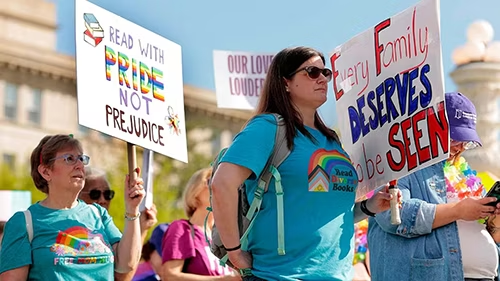
The U.S. Supreme Court made a decision earlier this summer that has a significant impact on classrooms nationwide. In their 6-3 decision in Mahmoud v. Taylor, the majority completely missed the point as to why LGBTQ-inclusive education matters. By giving parents the option to pull their kids out of lessons that include LGBTQ+ characters or content, the Court prioritized personal religious objections over creating schools where students can learn without feeling invisible.
Justice Alito‘s majority opinion is especially troubling. He treats LGBTQ-inclusive education as if it were some optional “add-on” that schools can easily work around. As a former teacher, I can confidently say that is not how education works, especially when it comes to curriculum and lesson planning. And while Justice Thomas calls LGBTQ-inclusive education “ideological conformity,” he fails to see that most LGBTQ+ adults today grew up in a school system that forced us to conform to a cisgender and straight worldview. Ironically, I’d consider the Court’s narrow view of public education to be ideologically driven. Read More

Dover Area school officials object to AP history textbook, arguing it is ‘anti-American’
October 20, 2025
Dover Area’s elected school board is set to vote Tuesday on a proposed Advanced Placement U.S. history textbook after some members objected to its use, arguing it would make students “anti-American.”
The textbook in question — “American History: Connecting with the Past,” by Alan Brinkley — was recommended by the high school principal and its social studies department, and signed off by Assistant Superintendent Timothy Mitzel.
Mitzel said the College Board recently updated the AP U.S. History exam to include the administrations of presidents George W. Bush and Donald Trump.
“This course has just had a rewriting of that AP exam to include the last 20 years of United States history,” Mitzel said. He added that a physical textbook allows students to collaborate and study more effectively than online materials. Read More

Book bans are being ‘normalized.’ What does that mean for classrooms?
October 8, 2025
Louisiana public school librarian Amanda Jones loves helping kids find the right book.
It’s her 25th year working in the Livingston Parish school district, the same one she attended as a kid. In 2022, she spoke at a local public library hearing about a challenge to remove a book about teen puberty, sexuality and consent from the shelves. She showed up with other community members to argue against banning any books from public libraries.
Soon, social media attacks started. She says commenters called her a “groomer” and a pedophile, publishing the name of her school and saying she was giving children pornography and erotica. Jones thought no one would believe them, but they did. She says she didn’t leave her room for four days, crying so hard her eyes swelled shut. She had debilitating panic attacks and was in and out of the hospital for two months. Jones brought a defamation lawsuit against a pair of conservative bloggers – seeking damages of $1 and an apology – that’s still ongoing. Whatever happens, she says she’s committed to staying on the job. Read More

Report: Florida leads nation in school library book removals
October 8, 2025
During the 2024–2025 school year, Florida schools pulled 2,304 books from library shelves — more than any other state for the third year, according to PEN America’s annual “Banned in the USA” report.
Why it matters: In recent years, Florida has gained national attention for its laws limiting classroom discussions and the rise of book challenges across the state’s school districts.
- The number of removals in the state decreased from the previous year (4,561 removals in the 2023–24 year), but advocates argue the continued campaign to remove books disproportionately impacts minority groups and furthers self-censorship.
What they’re saying: The “vast numbers” of books removed nationwide came “as a result of fear of legislation by school boards, administrators and educators” or “pressure imposed from the presence or threat of state laws,” according to the report. Read More

George Takei speaks out against censorship at BPL Banned Books Week event
October 7, 2025
As the First Amendment faces growing challenges, the Brooklyn Public Library (BPL) welcomed American actor, author and activist George Takei for an unscripted conversation on censorship at the Central Library at Grand Army Plaza on Oct. 6, as part of Banned Books Week 2025.
A few hundred book lovers filled the library’s lobby, greeting Takei — who served as honorary chair of Banned Books Week 2025 — with thunderous applause.
His conversation with librarian and poet Adeeba Rana focused on how to take action against book bans, along with a discussion of his graphic memoir “They Called Us Enemy.” The book, which tells the story of his family’s years in Japanese American internment camps, was banned in Tennessee in July 2024 and in Pennsylvania in 2023. Read More

Students and Librarians take S.C. Superintendent to Court Over School Censorship Rules
October 7, 2025
South Carolina public school librarians and students filed a lawsuit today asking a federal court to block enforcement of the state’s unconstitutional book banning regulation and a classroom censorship memo issued by the state education superintendent.
The lawsuit challenges the constitutionality of Regulation 43-170, which bans all materials in kindergarten through 12th grade public schools if they contain descriptions or depictions of “sexual conduct.” This regulation, which was promoted by Superintendent Ellen Weaver and took effect in June 2024, has led to the banning or restriction of 22 books statewide — the largest number of state-mandated school book bans in any state, according to PEN America. (See the full list of books below.) Read More
The Quiet Creep of Censorship: How ‘Everyday Banning’ Is Reshaping American Schools
October 5, 2025
In the spring of 2025, one of the most shocking facts about American public education is not that book banning exists—but that it has become both expected and “normalized.” According to PEN America’s October 2025 report, The Normalization of Book Banning, more than 22,810 instances of book bans have been recorded since 2021. The removal of books is no longer an anomaly; it is fast becoming part of public education’s institutional landscape.
This shift is more than alarming, it is a threat to the core of public education and free expression.
The transformation is systematic, multi-layered, and chilling in its implications. Once a book is removed, it seems very slow to return, even if its removal was under questionable circumstances. For instance, here in Central Bucks School District, two books were removed. They were Gender Queer and This Book is Gay. Read More

The 15 most banned books in U.S. schools
October 5, 2025
The most commonly banned books in U.S. schools include LGBTQ titles, international bestsellers, teen romantasy novels and a 1962 classic, according to a new report that compares modern-day censorship to Cold War-era McCarthyism.
More than 6,800 book bans were enacted during the 2024-25 school year in 87 public school districts across 23 states, according to a report released Wednesday by PEN America, a nonprofit that advocates for free expression. The report was released ahead of Banned Books Week, which starts Sunday.
“Censorship pressures have expanded and escalated,” Kasey Meehan, director of PEN America’s Freedom to Read program, said in a news release. “A disturbing ‘everyday banning’ and normalization of censorship has worsened and spread over the last four years.” Read More

Banned Books Week: A Local Reflection From a Pennridge School District Dad
October 5, 2025
Three years ago, I sat in a Pennridge school board meeting and listened as our directors claimed that “pornography” was rampant within our high school library. The first book they targeted was Allegedly by Tiffany D. Jackson. But the excerpt they read aloud that night wasn’t even real, it was cobbled together from bits and pieces of different chapters to make the novel sound obscene. Within days, that book and dozens more had vanished from high school library shelves. This was just the beginning.
This year, as Banned Books Week reminds us of the ongoing struggle for intellectual freedom, I cannot help but reflect on how local episodes like ours became part of a much larger movement. What began in small suburban school districts has grown into a larger coordinated effort, stretching from public libraries to museums, and even national institutions. Read More

Stephen King named most banned author in US schools
October 3, 2025
Best-selling author Stephen King was named the most banned writers of the 2024-2025 school year in PEN America’s latest report tracking book censorship in the U.S.
Some 87 titles among King’s oeuvre, which includes “The Stand,” “It” and “The Shining,” were banned 206 times during the school year, PEN America said.
Its report found that between July 2024 and this June there were 6,870 instances of book bans in 87 school districts across 23 states. PEN America counts any instance of a book pulled off a shelf as a ban.
Florida is called the top state for book banning for the third year in a row, followed by Texas and Tennessee. Read More

Book censorship in US schools has become ‘rampant and common’, free speech advocates warn
October 2, 2025
A free speech advocacy group warned on Oct. 1 that book censorship in public schools across the United States has become “rampant and common,” with book bans increasing significantly over the last few years.
Though book censorship is not a new issue, the United States has seen a sharp rise in book bans and attempted bans since 2021. PEN America’s “Banned in the USA” report, released on Oct. 1, recorded about 6,800 instances of books being removed from schools during the 2024-2025 academic year.
While the new number is down from the more than 10,000 bans reported in the 2023-2024 school year, PEN America noted that it was still an uptick from previous years when the advocacy group did not release an annual report or index of book bans. Since July 2021, PEN America has documented more than 22,800 cases of book bans across 45 states and 451 public school districts. Read More

23,000 Book Bans Since 2021: PEN America Releases Its Latest Report on the State of Literary Censorship
October 1, 2025
In the run up to Banned Books Week, October 5-11, PEN America has released their latest report on book bans over the last school year. Their findings continue to highlight what anti-censorship have been saying for years: the attacks are getting bigger, going higher, and continuing to happen at a whirlwind pace.
Before exploring the information in “The Normalization of Book Banning,” it’s worth providing a couple of important details. First: PEN defines a book ban as the removal of a book from the school shelves. This ban may be temporary or permanent; the removal is counted as a ban, as the material is unavailable for use. Second: PEN’s numbers are from reports of school book bans reported directly to them and those reported in the media. This means that there are likely additional book bans happening in schools, done either through quiet/silent censorship and/or simply not reported or accounted for. The data does not include books banned in public libraries nor prisons. Read More

How the Supreme Court Is Remolding Education in 2025
September 29, 2025
With many eyes on the Trump administration’s incendiary attempts to shutter the Department of Education and effectively dismantle public education, fewer people are closely watching how a conservative majority on the Supreme Court is changing how K-12 students learn in the country.
Nevertheless, the court delivered stark change in some instances, while narrowly upholding the status quo in others.
Some of the highlights:
Opting Out of Lessons
This last term brought Mahmoud v. Taylor, which handed a victory to religious parents looking to shield their children from LGBTQ-inclusive materials. The court ruled that Montgomery County Public Schools in Maryland had violated parents’ rights when it removed opportunities for parents to opt their children out of lessons with LGBTQ-inclusive materials. Functionally, this allows religious parents to withdraw their students from lessons with LGBTQ-inclusive texts, and it also requires schools to give notice when those lessons occur. Read More

George Takei to Lead Banned Books Week 2025
September 22, 2025
Out actor, author, and activist George Takei has been named honorary chair of Banned Books Week, which will take place October 5 – 11, 2025. Takei will be joined in leading the annual event by youth honorary chair Iris Mogul.
“Books are an essential foundation of democracy,” Takei said. “Our ‘government of the people, by the people, for the people’ depends on a public that is informed and empathetic, and books teach us both information and empathy. Yet the right to read is now under attack from school boards and politicians across America. I’m proud to serve as honorary chair of Banned Books Week, because I remember all too well the lack of access to books and media that I needed growing up. First as a child in a barbed-wire prison camp, then as a gay young man in the closet, I felt confused and hungry for understanding about myself and the world around me. Now, as an author, I share my own stories so that new generations will be better informed about their history and themselves. Please stand with me in opposing censorship, so that we all can find ourselves — and each other — in books.” Read More

An un-American story on book bans
September 18, 2025
Book bans might seem like small fry in the grand scheme of the USA in 2025, but speak to those on the frontline of tackling censorship and it’s clear this is about much more than reducing library catalogues. It’s about controlling ideas.
“Why books?” Sabrina Baêta of PEN America has often asked herself. PEN is an organisation at the intersection of literature and human rights, and Baêta is the senior programme manager of its Freedom to Read workstream around schools. “If you’re controlling books, you are controlling what people know and what people have access to,” she said.
Reading, she says, is a transformative experience. And the fact that books hold vetted information carries weight. Controlling books controls the narrative.
Book bans in school and public libraries have steadily grown in the USA over recent years, often spearheaded by co-ordinated right-wing groups – groups such as Moms for Liberty, which was established in 2021 to advocate for more parental oversight of discussions and materials in schools touching on issues such as LGBTQ+ rights and racial justice history. Read More

Federal judge overturns part of Florida’s book ban law, drawing on nearly 100 years of precedent protecting First Amendment access to ideas
September 17, 2025
When a junior at an Orange County public high school in Florida visited the school library to check out a copy of “On the Road” by Jack Kerouac, it wasn’t in its Dewey decimal system-assigned location.
It turns out the title had been removed from the library’s shelves because of a complaint, and in compliance with Florida House Bill 1069, it had been removed from the library indefinitely. Kerouac’s quintessential chronicle of the Beat Generation in the 1950s, along with hundreds of other titles, was not available for students to read.
Gov. Ron DeSantis signed the bill into law in July 2023. Under this law, if a parent or community member objected to a book on the grounds that it was obscene or pornographic, the school had to remove that title from the curriculum within five days and hold a public hearing with a special magistrate appointed by the state.
On Aug. 13, 2025, Judge Carlos Mendoza of the U.S. Middle District of Florida ruled in Penguin Random House v. Gibson that parts of Florida HB 1069 are unconstitutional and violate students’ First Amendment right of free access to ideas. Read More

‘Freedom to Read Act’ becomes law in Delaware
September 11, 2025
Delaware Governor Matt Meyer signed House Bill 119, or the ‘Freedom to Read Act’, into law Monday morning.
The newly established law sets statewide standards for how public and school libraries in the state manage challenges to literature on their shelves.
Under the legislation, libraries would be required to adopt written policies ensuring that books and other materials cannot be removed solely due to partisan, ideological, or religious objections. Public and school libraries would also need to establish clear review processes for objections, but materials under review would remain available until a final decision is made.
House Bill 119 also provides protections for librarians and library staff, prohibiting disciplinary action or retaliation against them for following the state’s principles on library material selection.
For school libraries, the legislation requires that only students, parents or guardians, and school personnel can object to materials, and it sets up an appeals process.Final appeals would be heard before a newly created School Library Review Committee, composed of education and library leaders, including the State Librarian, the Secretary of Education, and representatives from professional associations. Read More

Free Speech At Risk in America’s Schools
September 11, 2025
From military bases to public universities, censorship is spreading. The ACLU is pushing back to protect the right to read, learn, and speak without fear.
Across the country, lawmakers and federal agencies are attempting to censor what students and educators can read, learn, and discuss in classrooms. These efforts—whether banning books in Department of Defense schools, silencing teachers in Oklahoma and Florida, or chilling protests at universities—strip away fundamental rights and limit opportunities for an honest, inclusive education.
At the ACLU, we know that our rights don’t disappear at the schoolhouse gate. When government officials suppress ideas about race, gender, identity, or systemic inequality, they not only deny students an accurate education, they undermine democracy itself. That’s why we’re challenging these laws and policies in court: to ensure that classrooms remain places where young people can think critically, engage with diverse perspectives, and prepare to participate fully in civic life. Read More

Interactive Map Reveals Book Ban Hotspots and Nearby Little Free Library Locations
September 10, 2025
The Little Free Library® (LFL) nonprofit organization has released an updated version of its interactive Book Ban Map, developed in partnership with the American Library Association’s (ALA) Office for Intellectual Freedom and PEN America. First launched in 2024, the map now includes the latest data, highlighting where bans are intensifying and showing nearby Little Free Library book-sharing boxes where readers can freely access books.
With more than 200,000 Little Free Libraries worldwide, the nonprofit’s network provides a powerful outlet for those who wish to respond to book censorship. In 2024 alone, the ALA recorded 2,452 unique titles targeted for removal or restriction from school and public libraries. By overlaying book ban data with book-sharing box locations, the map gives communities a practical option for countering these challenges: give access to banned and challenged books through neighborhood Little Free Libraries.
“At the Little Free Library nonprofit organization, we believe that access to books is a fundamental right and a cornerstone of an informed, engaged society,” said Daniel Gumnit, CEO of LFL. Read More

Beyond The Shelves: How Book Bans In Schools Impact Students, Teachers And Community Members
September 4, 2025
Book bans in American schools are becoming more prominent every year. These bans target people of different ethnicities, sexualities, and identities. This significantly undermines students’ intellectual freedom and access to diverse perspectives as well as creating their own opinion on these subjects. There continue to be lingering questions on the topic: Are community members aware of the bans in their school districts? Does removing books that are collectively read in classrooms affect the curriculum and environment of the class? Is there a bias towards what books are banned in schools? Are parents the problem behind the bans? We asked circulating questions to teachers, library staff, and students to get more of an insight on the book bans taking place in American schools. Read More

Florida’s Incomplete Education: How Censorship Fails Our Students
August 29, 2025
In Florida, the State Board of Education wants the public to believe that schools are filled with obscene materials and that pressuring educators to ban books is both justified and necessary.
At its August 20 meeting, the board leaned heavily on falsehoods, repeating claims that classrooms and libraries are rife with “pornographic” content. In response, a coalition of parents, students, and authors held a press conference to set the record straight.
A summer-long censorship campaign led by the State Board of Education and the Office of Parental Rights began in Hillsborough County, where more than 600 books were pulled from public schools, and spread across Florida. Out of fear of legal consequences, at least nine counties have removed hundreds of books – including titles by Toni Morrison and Judy Blume – most without any formal challenge from local parents, as Florida law requires. Read More

Parents complained about ‘offensive’ book, so the principal read it to the entire school
August 22, 2025
Schools often have to walk a fine line when it comes to parental complaints. Diverse backgrounds, beliefs, and preferences for what kids see and hear will always mean that schools can’t please everyone all the time, so teachers and educators have to discern what’s best for the whole, broad spectrum of kids in their care.
Sometimes, what’s best is hard to discern. Sometimes it’s absolutely not.
Such was the case when a parent at a St. Louis elementary school complained in a Facebook group about a book that was read to her 7-year-old. The parent wrote:
“Anyone else check out the read a loud book on Canvas for 2nd grade today? Ron’s Big Mission was the book that was read out loud to my 7 year old. I caught this after she watched it bc I was working with my 3rd grader. I have called my daughters school. Parents, we have to preview what we are letting the kids see on there.” Read More

The most banned author in America refuses to be silenced
August 17, 2025
When U.S. Sen. John Kennedy, the Louisiana Republican, read a graphic passage from All Boys Aren’t Blue: A Memoir-Manifesto aloud during a 2023 Senate Judiciary Committee hearing — using his Southern drawl to recite lines about lube and sex in a tone somewhere between theater and scorn — he may have thought he was embarrassing George M. Johnson. But Johnson, the author of one of the most-banned books in America, saw something else entirely.
“It affected me, sure,” they say. “But it also put the book in places it never would’ve reached. Someone out there saw that clip, ordered the book, and found a story they didn’t know they needed.”
Published in 2020, All Boys Aren’t Blue was always meant to be more than a memoir. It was, as the subtitle declares, a manifesto. “I knew it was special,” Johnson says. “But I couldn’t have predicted it would become the center of a national conversation about censorship, education, and the erasure of queer Black truth.” Read More

“None Of These Books Are Obscene”: Judge Strikes Down Much of Florida’s Book Ban Bill
August 14, 2025
Judge Carlos Mendoza of the U.S. Middle District Court of Florida has ruled in favor of the plaintiffs in a major case related to book banning in the state. The 50-page decision, available here, states that the law used to pull books from Florida public schools is “overbroad and unconstitutional.”
Since its passage in 2023, Florida schools have removed hundreds of books under House Bill 1069 (HB 1069). HB 1069 required that school librarians remove materials from their collections that contain “sexual content,” regardless of the value of the book. It also allowed parents or county residents to raise objections to material, which then would need to be removed within five days of the objection and remain unavailable until the book was formally reviewed. The bill laid out no necessary timeline for review of material, nor did it require that material be returned to shelves, even following formal review. Read More

Banned Books Made Me a Better Reader
August 10, 2025
Banned books are a practice of censoring books. Though nowadays banning books does not mean book burning, but rather doubling down on taking books out of libraries and schools. In 2024 alone, over 10,000 books were banned all over the country. These bans usually happen for several reasons, sometimes to do with national security; see Operation Dark Heart. However, a large number of book challenges and bans happen because of debates around diversity and ‘explicit content.’
I committed to read numerous banned books, and decide for myself– should these books be taken off the shelves? Here is my answer: absolutely not. Every challenged book I have read and analyzed has affected me fundamentally; I get to see perspectives from characters who reflect what the world looks like and learn about difficult topics. Read More

‘A Win for Everyone’: Advocates Celebrate Passage of Rhode Island Freedom to Read Act
August 4, 2025
What began in 2023 as a group of just 10 Rhode Island Library Association members concerned about nationwide book bans blossomed into a coalition of more than 300 impassioned community members, whose collective advocacy culminated in the passage of the nation’s strongest Freedom to Read Act last month.
“This was not librarians against the world,” said Nicole Dyszlewski, a member of the Rhode Island Freedom to Read Coalition. “I think that was the key to success, that this wasn’t reduced to a librarian issue or a teacher issue or a parent issue. It was an everybody issue. It was a democracy issue. It was a diversity issue, and I mean that in the best way possible.” Read More

The Anti-Book Ban Laws Passed in 2025 (& What They Mean): Book Censorship News, August 1, 2025
August 1, 2025
This year has seen a fair share of states pass legislation that protects the right to read. Let’s take a look at the legislation in each of those states, what the legislation does and does not mean, the impact of such legislation in a post-Fifth Circuit landscape, and finally, collate all of the right to read/anti-book ban bills as they stand right now.
Note throughout that the titles of these bills all differ slightly, so I’ve used the language of the bills themselves when referring to specific state bills and more general phrases like “anti-book ban bill,” “freedom to read bill,” and/or “intellectual freedom bill” elsewhere.
In general, there are two types of anti-book ban bills being passed at the state level. The first ties a pool of money to libraries creating policies asserting that they will not ban books. Read More

Reading Banned Books Is Important but It’s Not Enough: You’ve Got to Take Action, Too.
July 21, 2025
Reading banned books is important for myriad reasons. You want to know what is so offensive as to create a moral panic, both historically and in our contemporary climate. You want to support the voices of those whose work is being suppressed, which is almost universally from marginalized communities. You want to lend your support, too, to libraries and bookstores who continue to offer these books to their communities.
But reading banned books alone is not enough to stop censorship. It’s not an action in and of itself that moves the needle in what is an attack on the very people these books represent. To effectively work toward ending book bans requires not only familiarity and passion for the books being removed. It also requires doing something that moves the needle, even if just a tiny bit. Read More

What’s Included in the 596 Books Banned by the Department of Defense Education Activity?
July 17, 2025
In early February, the Department of Defense Education Activity (DODEA) demanded the removal of hundreds of books from its schools across the globe. Materials included books that are out of alignment with the new administration’s “Defending Women from Gender Ideology Extremism and Restoring Biological Truth to the Federal Government” and “Ending Radical Indoctrination in K-12 Schooling” executive orders.
The DODEA operates 161 schools across seven states, Guam, Puerto Rico, and 11 countries. It serves approximately 67,000 students in military families.
This directive was met with near immediate pushback from military families worldwide, with students in several schools organizing protests in response. The American Civil Liberties Union filed a lawsuit on behalf of 12 DODEA families in April who believed that their First Amendment rights were violated via the book ban demands. Read More

St. Francis school district scraps book banning policy, will return titles to shelves
June 10, 2025
A lawsuit stemming from a book banning policy in the St. Francis school district has been settled, and the books will return to shelves.
In March, Education Minnesota-St. Francis and the American Civil Liberties Union of Minnesota filed lawsuits after the district adopted a policy that removed librarians and teachers from the book approval process and replaced them with a website called “Book Looks.”
The website, which shut down in late March, was affiliated with Moms for Liberty, a group at the forefront of the conservative movement targeting books that reference race and sexuality.
The website ranked the books from zero to five, with zero being “for everyone” and five being “aberrant content.” If a book with a rating of three or above was challenged, the policy dictated that it would be removed from shelves, the ACLU said in its lawsuit. Read More

No more Shakespeare? Staff warns West Shore School Board about proposed book policy
May 20, 2025
West Shore’s far-right school board majority is considering sweeping restrictions on the content of books in public school libraries, raising questions from administrators about the purpose of the new policy.
Staff in the school district that straddles the Cumberland and York county line warned that the broad language of the policy could result in banning books by Geoffrey Chaucer and William Shakespeare due to their references to sex.
Assistant Superintendent Mathew Gay, who previously worked as an English teacher, specifically cited “The Tempest,” a play by Shakespeare commonly taught in high school classes.
“[With this policy], I’m not sure we don’t inadvertently say you can no longer teach ‘The Tempest,’” he told the board’s policy committee on Thursday. Read More

Opinion: Locked out of the library: How book bans deprive young Americans
May 18, 2025
When the school librarian told me that “To Kill a Mockingbird” was deemed too unsafe for 6th graders at my middle school, I apologized, closed the book, and did not dare touch it again for another two years.
When the school librarian told me that “To Kill a Mockingbird” was deemed too unsafe for 6th graders at my middle school, I apologized, closed the book, and did not dare touch it again for another two years.
Ironically, for school districts and educational policymakers in the U.S., student safety and effective learning have not necessarily been presented as mutually exclusive values– however, recent calls for book bans in U.S. public schools have packaged access to literature in a false binary, with pressuring calls that one must be sacrificed for the other. Read More

OPINION: Book bans draw libraries into damaging culture wars that undermine their purpose
May 6, 2025
or the last four years, school and public libraries have been drawn into a culture war that seeks to censor, limit and discredit diverse perspectives.
Yet time and time again, as librarians have been encouraged or even directed to remove books that include LGBTQ+, Black, Latino and Indigenous characters or themes or history from their collections, they have said no.
When librarians said no, policy changes were submitted and laws were proposed — all in the name of controlling the library collection.
Some librarians lost their jobs. Some had their lives threatened. Legislators proposed bills that attempt to remove librarians’ legal protections, strive to prevent them from participating in their national professional associations, seek to limit some materials to “adults only” areas in public libraries and threaten the way library work has been done for decades. Read More

Bucks County Book Festival draws hundreds of readers, authors to main event
May 5, 2025
On Saturday, hundreds of people came out to Broad Commons Park in Doylestown for the main event of the seventh annual Bucks County Book Festival, a bustling, bibliophile-filled celebration of all things reading and literature.
More than 40 authors from the region and beyond signed books and spoke on panels throughout the day, as festivalgoers of all ages perused books for sale by both independently published authors and literary offerings from the Doylestown Bookshop and the Lahaska Bookshop.
Glenda Childs, co-chair of the Bucks County Book Festival, was one of the founders of the initial event, which took place in the fall of 2018.
She said the festival has grown and changed over the years, with a record number of organizers participating this year. Read More

Banned Graphic Novels Reinstated At Main Line School Library
April 23, 2025
The Radnor Township School District Board of Education Tuesday night approved the reinstatement of three graphic novels that were removed from the Radnor High School library after a parent filed complaints over their explicit content.
At a more than four-hour long meeting that also included budget discussions, the board addressed the issue of “Gender Queer” by Maia Kobabe, “Fun Home: A Family Tragicomic” by Alison Bechdel, and “Blankets” by Craig Thompson.
These publications were challenged by parent Michael Lake, who filed a Citizen’s Request for Re-evaluation of Material’s form, pursuant to Policy 144.1.
After Lake said the graphic novels contained “child pornography,” an anonymous ad hoc committee voted 5-1 to remove the materials from the high school library, deeming them not age-appropriate for students, in late February. Read More

NAACP Sues Department Of Education Over DEI Rollbacks: Here’s What To Know
April 19, 2025
The NAACP is suing the U.S. Department of Education over recent efforts to eliminate diversity, equity and inclusion (DEI) programs in schools. In a federal complaint filed in Washington, D.C., the organization alleges that the Department of Education’s recent directives are unconstitutional and discriminatory—particularly for Black students.
The complaint faults the administration for targeting programs that offer “truthful, inclusive curricula,” as well as policies that expand access to selective educational opportunities for Black Americans and foster belonging while addressing racism in schools.
The NAACP argues that the Department’s recent actions “advance a misinterpretation” of federal civil rights laws and Supreme Court precedent—actions that, according to the group, violate its members’ rights to equal protection and to be free from viewpoint discrimination under the U.S. Constitution. Read More

Book banning in America’s military academies could be the tip of the iceberg | PennLive letters
April 16, 2025
President Donald Trump’s State of the Union address last month claimed, “I have stopped all government censorship and brought back free speech in America.”
Three weeks later, in a brazen act of government censorship, Navy officials, following a Trump executive order, removed 381 books from the U.S. Naval Academy library, primarily books that examine race, ethnic, and gender relations.
It is a cliche to say that the connections between Trump’s pronouncements and his actions are Orwellian, but it is true, nonetheless.
The books purged — to give just two examples — include “My Vanishing Country,” a memoir by a young Black South Carolina legislator which has been compared to JD Vance’s “Hillbilly Elegy,” and “Evil Eye,” a novel about Palestinian American life. Read More

The ACLU and Pentagon School Students Sue Over Book Bans: Book Censorship News, April 18, 2025
April 18, 2025
This week in book-banning news, the lawsuits continue: the American Civil Liberties Union is suing the Department of Defense’s education agency on behalf of twelve students who argue that their First Amendment rights are being violated by censorship in their schools. Plus, the first public library to become a book sanctuary in Pennsylvania, the dismissal of a Michigan pro-book-banning lawsuit, and the spillover of book ban rhetoric into the UK.
While Kelly Jensen is off this week, the rest of the editorial team is filling in to cover censorship news! The first story you’ll read below is by Danika Ellis, the next two are by Erica Ezeifedi, and the last is by Rebecca Schinsky. Read More

These Students Fought Book Bans…and Won
April 18, 2025
The Kids Are All Right
Elizabeth Foster is one of the three student activists featured in the new documentary Banned Together, which captures the aftermath of a 2022 book ban in Beaufort, SC and the greater context of book banning efforts nationwide. In a terrific new piece for Teen Vogue, Foster recounts how she fought censorship in her hometown, and won. She and her fellow student activists get it.
The book-banning movement is about something so much bigger than books. The same movement started by attacking Critical Race Theory as a proxy for targeting Black and brown students. Queer and transgender students — like my own brother — were added to the list of demonized identities as far-right extremists came after their stories in schools and libraries. Read More

Book bans: ‘This is how tyranny happens’
April 16, 2025
Re: “Who’s in and who’s out at the Naval Academy’s library?” (April 11, Nation):
Following President Donald Trump’s executive orders targeting diversity, equity and inclusion, the U.S. Naval Academy has banned “nearly 400 books.” The list includes celebrated American favorites but leaves on the shelves some very disturbing and controversial writing (“Mein Kampf,” “The Bell Curve,” etc.). This book banning removes anything that smacks of Trump’s personal hate list, which includes anything LGBTQ and some respected African American titles.
We are watching this playlist to tyranny play out right in front of our eyes. As a retired librarian, I have seen some of these attempts before, but never so audacious and pushed by the leader of our country who is destroying dissent, step by step.
This is how tyranny happens. Read More

Students sue US Defense Department schools for book removals
April 15, 2025
A dozen students in U.S. Defense Department schools sued, opens new tab the department and Defense Secretary Pete Hegseth on Tuesday for book removals and curriculum changes following executive orders from President Donald Trump, an advocacy group said.
The lawsuit was filed in the U.S. District Court for the Eastern District of Virginia by the American Civil Liberties Union on behalf of 12 students from six families who attend schools as children of active duty service members, the ACLU said on Tuesday.
KEY QUOTES

‘All children should feel safe to use the bathroom’: Sarah and Ian Hoffman on writing to create a culture of kindness
April 15, 2025
When Sarah and Ian Hoffman’s son Sam was two years old, he started being attracted to objects and activities that were generally considered “girl things,” including pink sneakers and t-shirts, then princess dress-up costumes, tiaras, and fairy wings. Then he wanted to wear a dress to school, and the couple found themselves trying to balance supporting Sam’s intense desire to be himself with concerns about his safety and wellbeing.
They had no support network at first, but over time found programs that helped introduce them to other families with gender-nonconforming kids. Sarah started writing about the topic for parents so they could feel less isolated and know how to support their kids. Read More

Banned Books and Censorship: Who Gets to Decide What We Read?
April 15, 2025
To Kill a Mockingbird by Harper Lee, 1984 by George Orwell, and The Catcher in the Rye by J.D. Salinger are all beloved contemporary classic novels that teach us valuable life lessons and are known as literary masterpieces. These books have also be frequent victims of book bans and censors around the world.
This begs the question — why exactly are books banned, what impact does this have on people, and are book bans ever justified? Read More

Top 5 book ban attempts in 2024 focused on queer themes
April 14, 2025
The top five books that extremists tried to ban in 2024 had queer themes, the American Library Association said in its latest report.
“State of America’s Libraries 2024,” released last week, details 821 attempts to ban or censor books and related LGBTQ+ services at libraries and educational facilities in 2024.
“The most common reasons for challenges were false claims of illegal obscenity for minors; inclusion of LGBTQIA+ characters or themes; and dealing with topics of race, racism, inclusivity, equity, and social justice,” the American Library Association said in its report. Read More
Fact Sheet: Mahmoud v. Taylor, the U.S. Supreme Court Case About Banning LGBTQ-inclusive Books
April 10, 2025
The Supreme Court of the United States is scheduled to hear oral arguments in Mahmoud v. Taylor on Tuesday, April 22, 2025.
Mahmoud v. Taylor is about a small number of LGBTQ-inclusive children’s books included in the classrooms of Montgomery County (Maryland) Public Schools. The books were chosen and evaluated by education professionals. Six parents (three couples) sued the school district board of education claiming their religious freedom was violated by not having an option to opt out their children from classrooms where the books might be part of curriculum, including when offered as nonmandatory supplemental learning materials. Read More
PEN America and Maryland ACLU Argue in Legal Filing that U.S. Education Department Policies Will Turbocharge Book Bans and Expand Censorship
April 7, 2025
PEN America has filed a “friend of the court” brief, together with the ACLU of Maryland, in a case challenging the Trump administration’s sweeping assault on free speech and ongoing campaign to eliminate views other than those it favors on race, equality and identities in schools and universities.
The brief filed Friday in the U.S. District of Maryland supports a lawsuit brought by the American Federation of Teachers, its Maryland chapter, and the American Sociological Association, challenging the Department of Education Office of Civil Rights’ “Dear Colleague” letter of Feb. 14 that calls on all schools (from pre-K to higher education) to end “illegal DEI practices.” Read More

Right To Read: 4 Advocacy Organizations With Resources To Fight Book Bans
April 7, 2025
Today, I find myself reflecting on Jodi Picoult’s bestselling novel Nineteen Minutes, a harrowing account of the moments leading up to a school shooting. It was among the top books banned during the U.S. 2023–2024 school year according to PEN America, and it contains a quote that I find very poignant: “If we don’t change the direction we are headed, we will end up where we are going.”
Book bans have already risen to unprecedented levels in recent years. Since 2021, PEN America has reported nearly 16,000 book bans in U.S. public schools nationwide—a number not seen since the Red Scare McCarthy era of the 1950s. By banning books, we are limiting access to stories that reflect a wide range of experiences and put young readers at a severe disadvantage. As a society, we all suffer under censorship. Read More

Pine-Richland passes final read of controversial library policy, defining process to challenge books
March 17, 2025
Pine-Richland school directors Monday passed the final reading of a controversial library book policy, bringing to an end a contentious year-and-a-half process and potentially kick-starting major changes into which books will be offered in school libraries.
Directors in a 5-4 vote approved final changes to Policy 109.1, which lays out how library books are selected as well as the process to challenge books. Approval came despite last-ditch efforts from residents and some board members to keep the policy as it’s currently written.
“This policy, born from a vague and troubling process with unclear origins, ignores the voices of parents, students and the community,” Director Ashely Fortier said prior to the vote. Read More

The rise in book bans raises fears of suppressed voices for educators
March 17, 2025
As efforts to restrict access to certain books increase throughout the country, educators, activists and readers are pushing back, arguing that limiting perspectives in literature is a dangerous step toward silencing entire communities.
“I think you can’t really fight book bans without taking a larger approach to thinking about community defense and liberation because book bans aren’t really about books, right? They’re about people,” said Libertie Valance, a co-owner and community events coordinator at Firestorm, a local anti-fascist bookstore.
According to Valance, the far right has initiated a personal attack on access to literature related to black history as well as queer and trans-life experiences. She said ultimately, the conservative segment of the political body wants to see those groups of people further marginalized or even fully erased from society. Read More
Radnor school district will review its library policy after backlash over book bans
March 12, 2025
Radnor school officials said they will review their library selection policy amid community backlash over the district’s decision to ban three graphic novels last month.
During a school board policy committee meeting Tuesday, administrators — who have said the removals of Gender Queer, Fun Home, and Blankets were in line with the district’s policy — acknowledged the complaints. They said they would research other school policies, consult with librarians, and review best practices from the American Library Association before bringing information to the committee in April.
Susan Stern, the policy committee chair, said board members want to give administrators time “to do that work thoroughly.” Read More

A threat to literature: How Project 2025 will affect school libraries
March 10, 2025
The conservative Heritage Foundation has devised a set of policies known as Project 2025 that President-elect Donald Trump is expected to initiate within his first 180 days in office, according to CBS News. During this year’s election, President Joe Biden, Vice President Kamala Harris and other Democrats associated Project 2025 with Trump and his administration’s plan for his presidency. However, Trump and his campaign have worked to distance themselves from the accusation. Trump has even called some of the proposals in Project 2025 “abysmal,” according to CBS News.
To high school students and teachers, one of the most impactful policies in this plan is the proposed book ban, which would affect school libraries throughout the United States. Read More

New data shows US authorities ban majority of books with race and gender themes
March 3, 2025
Books focusing on race and LGBTQ+ subjects were the majority of those attacked by book bans across the US in the past year.
A new study by PEN America has revealed that the majority of books banned in US schools were about racial or sexual diversity. Of the 4, 218 unique banned titles in the 2023-2024 school year, 36% featured fictional characters or real people of colour. 29% of banned books included LGBTQ+ characters, people, or themes. Related Celebrities and media figures criticise BBC for pulling documentary ‘Gaza: How to Survive a War’ One month in, how has Trump impacted culture around the world? Today, more than half of all American schoolchildren are people of colour, yet across the country there has been a concerted attempt to reduce students’ access to literature on race. Read More

New Analysis Shows Book Bans Target Books With Non-White, Queer, and Disabled Characters
February 28, 2025
PEN America has released a new analysis of book bans, Cover to Cover, and it really makes clear the purpose of book banning—which, surprise surprise, is not what book banners say it is.
For one, in the more than 10,000 book ban instances that PEN America looked at—which span across genres, fictional and nonfictional books, and even picture books— 36% involved books that featured fictional or real people of color. They also found that of the banned history and biography titles, 44% were centered around people of color, and 26% of banned books within the same category were about Black people, specifically. This, in addition to other facts, led them to the conclusion that the current deluge of book bans we’ve been seeing these past few years is based around white supremacist ideology. Read More

Banned Books and Local Bookstores at F&M
February 26, 2025
Last Friday, February 21, students had the opportunity to buy, or simply take in, tables of Banned Books that filled the College Center atrium. Sponsored by the Writers House, five local bookstores – Nooks, Read Rose, Aaron’s Books, Pocket Books, and College BookStore – displayed books spanning genres like African American Lit and History, Queer Lit, Graphic Novels and Memoirs, and Classics. Students had the chance to pick up free stickers and pins. Additionally, the first 100 students to attend the fair were given a $20 voucher to buy a book of their choice. Miles Montalvo 25’, co-organizer of the book fair, was ecstatic that these vouchers “were gone before lunchtime,” as the event started at 10 a.m. Read More

Book bans and DEI backlash aren’t about unity. They’re erasing Black history. | Opinion
February 17, 2025
In a recent guest column for the Tennessean, Tennessee educator Joseph Murray lambasted DEI, arguing that the acronym stands for “division, excuses and identity” instead of “diversity, equity and inclusion.”
Of particular concern, he wrote, is the impact of DEI in the classroom. And though he focused much of his attention on Frances Rosales’s opinion that diversity amongst teachers is important, Murray opened his piece with a discussion of Morgan Freeman’s 2005 appearance on “60 Minutes.”
In the interview, Freeman said that “Black history is American history” and called the concept of Black History Month “an insult.” Read More

Julianne Moore says her book about embracing differences was removed from Pentagon-run schools
February 17, 2025
Oscar winner Julianne Moore claims her children’s book “Freckleface Strawberry” was banned by the Department of Defense’s Education Activity, a global network of 160 schools serving military families.
In a post Sunday on Instagram, Moore expressed a “great shock” about the decision to yank the book for review and said she wrote the book for her children and other kids “to remind them that we all struggle but are united by our humanity and our community.”
The Pentagon agency that is reviewing books in its school system says some have been removed on a temporary basis but none have been banned thus far.
The book, published in 2007, is the first in a series of semi-autobiographical stories by Moore about Freckleface Strawberry, a 7-year-old girl “who’s learning to love the skin she’s in,” according to the series’ website. Read More

Books mentioning slavery, civil rights removed from shelves at Fort Campbell schools
February 13, 2025
At an elementary school at Fort Campbell, home of the 101st Airborne Division, librarians are hard at work scrubbing the shelves. But they aren’t scrubbing for dust. They’re scrubbing for books that contain references to slavery, the civil rights movement and anything else related to diversity, equity and inclusion.
On Feb. 6, DoDEA (the Department of Defense Education Activity) sent to administrators and school employees at 161 schools around the world a letter “to ensure compliance with executive orders and recent DoD guidance.”
The letter, a copy of which was obtained by Clarksville Now, lays out several new directives. Many of them were expected, including that programs designated for girls “may only be accessed by biological females,” and that signage for restrooms and locker rooms must use terms such as “women” and “men” or “girls” and “boys.” Read More

Librarians work to keep books available for everyone
February 13, 2025
Everyone seems to be able to agree that February is recognized as “I Love to Read” month. It is also National Library Lovers’ Month.
But sometimes, people have differences of opinion on exactly what people, especially young people, should be reading and what should be on the shelves at the library. Local librarians are trained to walk that line, and a new state law is helping to shape that conversation.
A Minnesota bill with a section prohibiting book bans in public libraries and libraries, or media centers, in public postsecondary institutions and schools was signed into law by Governor Tim Walz on May 17, 2024. The law allows for “challenges” for books, and instructs libraries to have a challenge policy in place. Read More

Book bans could escalate after Department of Education dismisses censorship complaints
February 8, 2025
The U.S. Department of Education is stepping away from the fight over book bans, a move civil rights groups warn could give local officials more power to censor books on race, gender and identity.
Why it matters: Librarians and legal experts argue that book bans threaten First Amendment rights, warning that government censorship jeopardizes free speech and silences marginalized voices. Read More

Multi-level barrage of US book bans is ‘unprecedented’, says PEN America
February 7, 2025
Book banning in the US has surged in the past few years, fueled by conservative backlash against discussions of race, LGBTQ+ issues, and diversity teaching in public schools. Last week, the Donald Trump administration instructed the Department of Education to end their investigations into these bans, calling them a “hoax”.
PEN America, one of America’s largest non-profits dedicated to protecting free expression in literature and beyond, warns that the current barrage of book bans and the growing traction of the movement is dangerously reminiscent of authoritarian regimes throughout history. Read More

Banned Books List 2025
February 4, 2025
What books are banned in 2025? Thousands of titles have been removed from public schools across the country.
PEN America has documented nearly 16,000 book bans in public schools nationwide since 2021, a number not seen since the Red Scare McCarthy era of the 1950s. This censorship is being mobilized by conservative groups— and has spread to nearly every state— and predominantly targets books about race and racism or individuals of color and also books on LGBTQ+ topics as well those for older readers that have sexual references or discuss sexual violence. Read More

A Tallahassee Episcopal priest leads the local fight against challenged and banned books
January 31, 2025
This week a Florida judge dismissed a lawsuit that would have allowed parents to challenge a school district’s decision to remove a school library book. The move comes as the Trump Administration is dismissing 11 complaints against school districts for that. But there was a bit of push-back in Tallahassee Thursday night.
Susan Gage, an Episcopal priest, assembled a group of authors to read selections from challenged and banned books at the Req Room on Monroe Street. Read More

Statement from the Kids’ Right to Read Project on the U.S. Department of Education’s Dismissal of Book Bans as a “Hoax”
January 27, 2025
The Kids’ Right to Read Project (KRRP), a signature initiative of the National Coalition Against Censorship (NCAC), has been at the forefront of defending the freedom to read for over 20 years. We condemn the recent actions by the U.S. Department of Education in dismissing complaints about book bans and referring to these challenges to access as a “hoax.” This rhetoric is not only dismissive of the reality of censorship in schools, but it also ignores the voices of students, educators, librarians, and parents who are actively engaged in advocating for the freedom to read. Read More

ALA to U. S. Department of Education: Book bans are real
January 26, 2025
The American Library Association released the following statement in response to the January 24th announcement that the U.S. Department of Education’s Office for Civil Rights (OCR) is arbitrarily dismissing student and parent complaints arising out of public schools’ documented acts of censorship and discrimination:
In their cruel and headlong effort to terminate protections from discrimination for LGBTQIA+ students and students of color, the Department of Education advances the demonstrably false claim that book bans are not real. Read More
Pine-Richland School Board rejects book for ninth graders, continues to debate a book policy during a heated meeting
January 14, 2025
Pine-Richland Superintendent Brian Miller called language proposed for a controversial library book policy that has been in the works for months “unnecessary and potentially harmful” during a nearly five-hour board meeting that once again turned heated and also included the school board rejecting a book for ninth graders.
Mr. Miller’s remarks came as the board prepares to do a first read next month on major changes to Policy 109.1, which lays out how library books are selected as well as the process to challenge books. Read More

‘Anti-trans bias’: Florida school district met with blowback for banning LGBTQ+ book
January 13, 2025
The world’s largest book publisher is urging a Florida school board to put a children’s novel featuring a transgender character back on shelves.
Penguin Random House, along with national free expression organization PEN America, said in a Tuesday letter to the Escambia County School Board that the decision to remove “Too Bright to See” by Kyle Lukoff from its libraries represented “further steps to restrict Escambia County students’ right to read and put their ability to learn in jeopardy.”
Escambia, Florida’s westernmost county, has been a hot spot for book banning. It’s drawn two notable federal First Amendment lawsuits, including one from PEN America and Penguin Random House. Read More

Pine-Richland School Board meeting on controversial book policy turns heated
January 10, 2025
Pine-Richland school directors in a heated meeting Thursday night spent nearly seven hours tediously reworking a controversial library book policy that has been under scrutiny since 14 books deemed inappropriate by some were challenged in fall 2023.
The joint governance meeting, which at times devolved into shouting matches between more than 50 residents and board members calling for order, focused on changes to Policy 109.1. The policy lays out how library books are selected as well as the process to challenge books.
Proposed changes completely overhaul the policy as it currently reads, with the goal of providing more parental oversight while adding language such as “explicit sexual content.” It also gives the board more control over the selection process and final determinations of challenged books if an appeal takes place. Read More

Pennsylvania school board to discuss revised book policy
January 9, 2024
During a meeting on Thursday, the Pine-Richland school board is expected to discuss a revised policy that will determine if a book is banned or not. Watch Here

Librarians gain protections in some states as book bans soar
January 7, 2025
New Jersey just joined at least 5 other states that have taken steps against school library censorship.
Karen Grant and fellow school librarians throughout New Jersey have heard an increasingly loud chorus of parents and conservative activists demanding that certain books — often about race, gender and sexuality — be removed from the shelves.
In the past year, Grant and her colleagues in the Ewing Public Schools just north of Trenton updated a 3-decade-old policy on reviewing parents’ challenges to books they see as pornographic or inappropriate. Grant’s team feared that without a new policy, the district would immediately bend to someone who wanted certain books banned. Read More